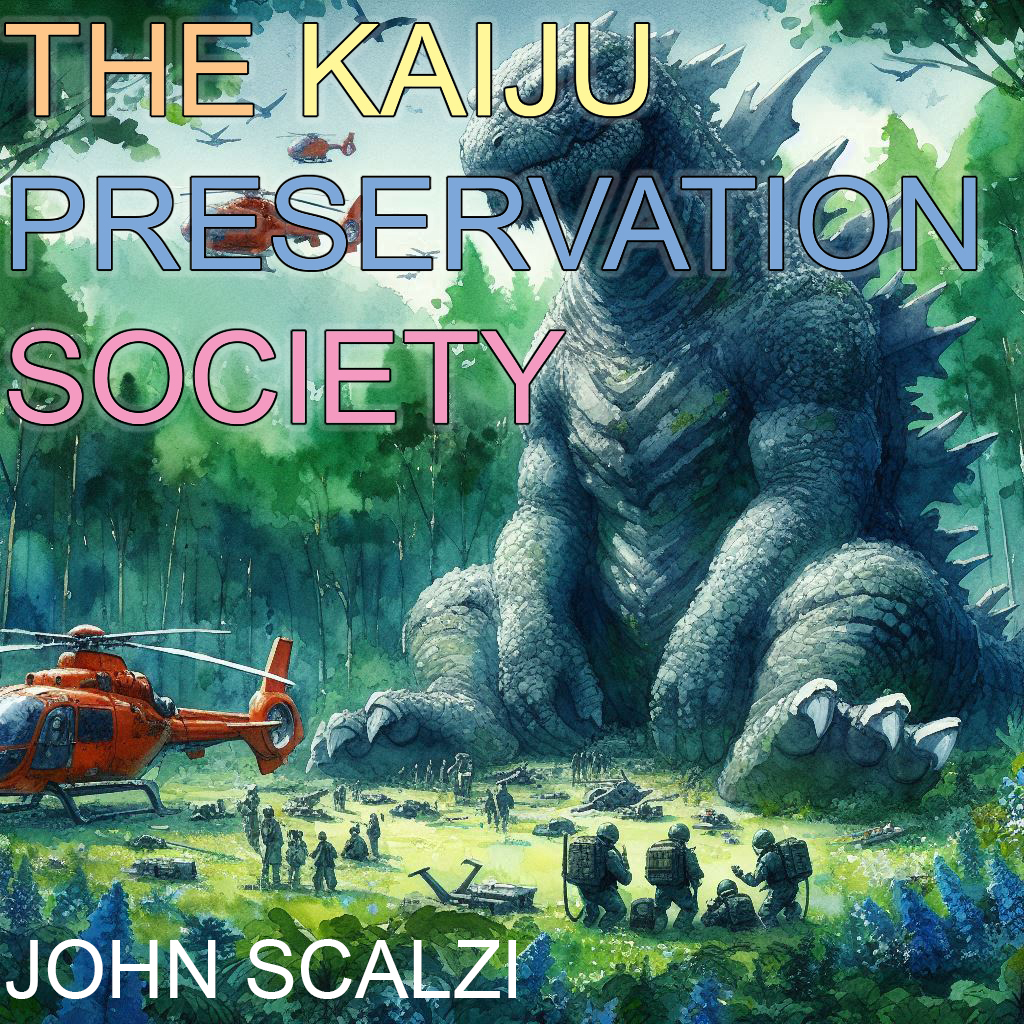
The Kaiju Preservation Society

John Scalzi

I started off really liking the premise, and still did going forward. But the writing was just insufferable. This style, I later found, is something that John Scalzi is known for. The characters are one-dimensional beings with non-stop banter appreciated by 12 year olds. The protagonists laugh in the face of life-threatening danger, and the villains go into long monologues without taking any action. I’ll introduce some Scalzi like lines here in this review.

I have a few small words for this book on large animals.

There was some light applause, and *insert name here* hooted and gave a quick whistle.

I nodded towards the whistle, and continued, “As I was saying, the book is about Kaijus and preserving them. An excellent concept for a sci-fi book. There must be some characters who are brave; well, it is about preserving Kaiju!”

Everyone laughed.

The characters are all PhDs. And a PhD can obviously master a new world with an “impossible to exist” species in a few weeks. And well, PhDs are condescending, right? They all love to banter. And how they love it! They love it so much, they have forgotten how a normal conversation is had.

To join the KPS, one needs no qualifications. Fitness tests and mental aptitude are for the loser non PhDs. Here, only banter skills are important.

There were a few laughs.

This whole book feels like there is one character who wears different names. Everybody speaks the same. Everybody is a PhD (except our hero who drops out of his PhD program). Everybody is ALWAYS “bickering” and wanting to one-up the other, who is again the same person. Everybody laughs at everything. Everybody is passionate about entering this world full of radiation and dangerous swamp monsters. Everybody is just exhausting. Everybody is the hero and the villain.

The author even brings up “Snow Crash” in the beginning, whose hero is… well, Hiro Protagonist. The irony is surely lost on the author? Or his writing is probably just too advanced for me. Our characters here can be named by a number and an alphabet, and it would make it easier to remember the characters than the names used.

There were a few chuckles at this point.

The Kaiju are walking nuclear reactors with a host of parasite employees to keep them running as per schedule. So far, so good.

There are about 10 Ethan Hunts on base. Sorry, Dr. Ethan Hunts. The KPS is funded by governments and billionaires, most of whom are quite nice, but also very witty and smart. Probably PhDs.

At this point, the entire non-PhD crowd like me gave a rousing cheer.

“I can’t believe I’m the one saying this to you,” Aparna said to Niamh. “But, wow, you’re sure whining a lot right now.”

A random line pulled from this book which basically sums up the entire character spectrum, which is quite small and narrow enough to round off to one.

That said, Scalzi’s strength lies in his world-building and the integration of kaijus into a modern, secret ecosystem.

This is my first book by John Scalzi. While I found the character similarities and relentless banter a bit overwhelming, I appreciate his imaginative approach to the genre. I’m going to give “Old Man’s War” a try because Scalzi’s storytelling and creativity are worth exploring. If the dialogues are going to be the same, then he might not be the author for me, but I’m open to being surprised.


“Just the worst,” Aparna agreed. “History’s worst monster,” I said. “I can still have you shot in the gut,” Sanders said. “Like, all of you.” “Oh, right,” Kahurangi said. He pressed the button, and then tossed the remote back to Sanders. “By the way, I lied.” “You what?” “He lied,” I said. “So did I.” “We all lied,” Aparna said. “Not about liking each other,” Niamh said to Sanders. “We do. And not about you being an asshole. You are.”

I lied about the appreciation too. I really don’t see how anybody over the age of 14 can like this writing style. And shame on the Hugo awards for nominating this book. Surely this couldn’t have been one of the top five in that year?

Everybody jumped out of their seats and clapped and cheered.

*Insert Obama awarding Obama meme*

THE IMMORTAL LIFE OF HENRIETTA LACKS

REBECCA SKLOOT

I have finally decided to pick this book up after five years since having bought it. I am writing a review for this book as I read it, with periodical updates every few pages. Recently, I have been giving in to writing the review anytime from immediately after, to a month or two (or three) later.

The book has started off as an introduction into how the author initially came upon this topic of the HeLa cell line in her college, and then subsequently tried to learn more about the original creator (or owner?) of the great-great-great…great grandmother cells of the current HeLa cells present in probably every cell lab in the world.

I am currently 100 pages in and have not found the book to be very interesting. It feels a bit like these chapters have been added to boost the page count, or to provide a bit of meaning to all the drudgery that was involved in the research process of writing this book. The first chapters discuss the life of HL growing up, and how the tobacco farms were tilled and harvested by the Lacks family. And then about her early life and the cancer itself that was serendipitously put in a cell culture that has given us the immortal cell line and all the associated benefits. The method and the results, as pointed out by the author, have repeatedly come under scrutiny with the morality of the future.

Currently at 250 pages in, and the previous point stands. The chapters about the author’s interaction with the family and how tough it was to gain their trust might seem interesting to some, but not to me. Again, it feels like the entire reason those portions were added was to create drama where there was very little. The portions that explain what goes on in the scientific world on the other hand are still interesting and memorable. By this stage though it might have been better to name the book the very mortal life of Deborah Lacks. I can’t say I am too interested in the life of the children of Henrietta.

With the book completed, my position as it stands today is clear that the progress in science should not be held back by consent forms and personal beliefs of the patients/subjects. In the specific case of Henrietta Lacks, it is deplorable that her children must struggle for health insurance and the general unaffordability of medication for their respective illnesses. An honorary position on some foundation dedicated to Henrietta Lacks with a token stipend and medical cover would be fair compensation. But beyond that, the expectation of a royalty for the mere fact that they are descendants of the patient is not a fair argument for perpetual royalties.

There might be an argument to be made that similar to how artist royalties and scientific patents continue to generate revenue long after the passing of the primary artist or inventor, the cell donors also have a right to receive a portion of the profits. When the offspring of a landlord continues to receive rent, why not the offspring of the donor of the HeLa cell line?

In my opinion, a just society must reward the engines behind growth. Contribution is mandatory for credit – be it monetary or acknowledgement. In scenarios such as the Henrietta Lacks immortal cell line, the primary actors were the lab that cultured the cells, the hospitals that supported them, the patient herself to a certain degree. If there were a continued collaboration between the patient and the scientists, that would mean that there is significant contribution without which the science could not continue, and thus would entitle the patient to credit as a contributor to growth. But otherwise, I do not believe there should be continuous monetary compensation for a one time donation, especially when it might have been made to benefit the patient.

THE HIDDEN LIFE OF TREES

PETER WOHLLEBEN

This book, like the other books I am reading this year, had been languishing on my shelf being neglected and gathering dust before I finally picked it up. I had started this book once or twice earlier and dropped it after a few chapters for no particular fault of the book itself.

This was an effortlessly readable book that sheds an empathetic light on trees and forests unlike the other general science literature on similar topics.

The book starts off strong with chapters dedicated to the underground root-fungi network, which has cleverly been dubbed WWW – the Wood Wide Web. It is from this point that the book truly takes root (heh), presenting trees and forests as beings far grander than conventional wisdom would suggest.

There’s a touch of science with a healthy dose of humanism and a pinch of assumptions in each chapter. Sometimes the assumptions are the author’s hopes on the topic, other times they are the “voices” of the trees. A bit of further reading on the internet affirms the view that the factual aspect of the book is not as rigid as I had hoped for, but the sentiment of the author behind those chapters is certainly pure, and I do not hold his hopes against him. I might not directly relate to the sentiment he has associated with trees, but I do respect the care and depth he has gone into for his craft.

I found the chapters about how each species behaves differently in both small and big aspects, trees “talking” to each other, having something akin to mother – child relationships, all of which ensure the survival of the next generations and the forest as a whole to be quite interesting. It would be both horrifying and exciting if we were to find out that trees have always had a sense of consciousness and intellect.

I hope there is an equivalent book on Indian trees and forests, as this book is completely about European forests and tree species. Most of the species mentioned in the book have one or two subgenera in India, and those, too, are presented in the Himalayas or on narrow strips of land bordering China. Once I finished reading the book, I did start noticing a bit more about the trees that grow around me in the city, such as the shape of their trunks, the spread of their branches, the angle by which they lean, and sometimes I felt I could even identify if the tree is in “pain.” I hope to reread this book one day in the future.

MERCHANTS OF DOUBT

Naomi Oreskes and Erik M. Conway

If How to Lie with Statistics by Darrell Huff is a manual on the manipulation of data, Merchants of Doubt is a record of the practical implementation of the principles outlined in the former. The book extensively cites over 100 sources per chapter, demonstrating how organizations and companies collaborated to create an atmosphere of fear, uncertainty, and doubt in the American media. While the focus of this book is primarily on the United States, similar manipulation can be found in other significant economies with sufficient investigation. Merchants of Doubt documents and exposes the tactics used by lobby groups, particularly those associated with Big Tobacco, which have had direct and indirect consequences, including the erosion of genuine scientific research and the loss of millions of lives.

The book explores how a small group of influential figures, lacking expertise in the subjects they lobbied for, shaped public perception on various issues, including tobacco, weapon technology, climate science, and CFCs. Due to its heavy reliance on citations, the book can be quite dense, making it challenging to read. Although I had unsuccessfully attempted to read it a few times over the past five years, I eventually powered through and completed it. Simplifying the book’s content would have compromised its seriousness and professional tone, which is a decision left to the authors.

Nevertheless, Merchants of Doubt provides a compelling case against corporate lobbying and late-stage capitalism. It unequivocally demonstrates how the ability of a privileged few to manipulate media discourse on significant matters will lead to long-term harm. The unchecked weaponization of free speech, even through well-intentioned policies like the now-removed Fairness Doctrine, will persist as long as these actors maintain a stranglehold on politics. To circumvent laws, and to portray authority, these organizations funded and created think tanks and lobbies to forward their agendas. The lobbies have and continue to exploit the system by putting forward arguments which fall under well established logical fallacies.

The problems are evident, the actions well documented, and the solutions fairly obvious. Yet if the history presented in this book is anything to learn from, the solutions will be implemented after the harm done is irreversible, the last profit which can be made is made, and a great struggle has been put up by a few dedicated good faith actors.

A GENTLEMAN IN MOSCOW

A Gentleman in Moscow is a novel by Amor Towles that tells the story of Count Alexander Rostov, who is sentenced to house arrest in the luxurious Hotel Metropol in Moscow. The book follows Rostov as he adapts to his confined lifestyle and forms relationships with the hotel staff and guests.

I found this to be a feel-good book that may appeal more to an older audience. The story is slow-paced and focuses more on character development and the relationships between the characters than on action or excitement. It is a pleasant and enjoyable read, but it may not be suitable for readers who prefer more fast-paced or slightly more thrilling stories.

A Gentleman in Moscow has a sentimental tone throughout the book. The main character, Count Alexander Rostov, is a former aristocrat who is sentenced to house arrest in the Hotel Metropol in Moscow by the Soviet government. Rostov’s confinement in the hotel is a result of the political upheaval of the time, and the novel explores the ways in which the political changes in Russia affected the lives of ordinary people. Rostov forms close relationships with the hotel staff and guests, and the novel explores the themes of friendship, loyalty, and the importance of human connection. The story is set in Moscow, Russia, during the early 20th century, and Russian history plays a significant role in the story. The novel is set against the backdrop of the Russian Revolution and the rise of the Soviet Union, and the political events of the time period are a key part of the story.

Rostov’s interactions with the hotel staff and guests are often heartwarming and tender, and the novel celebrates the power of human kindness and compassion. It is a story about the enduring strength of the human spirit and the ways in which people can support and uplift each other, even in difficult circumstances. The quips by the Count are quite witty and humorous, which is a contrast to the dark and lonely times experienced by him.

Loss is a significant theme in A Gentleman in Moscow. The main character, Count Alexander Rostov, experiences a number of losses throughout the story, including the loss of his freedom, the loss of his former lifestyle, and the loss of loved ones.

In addition to the historical context of the Russian Revolution, the novel also touches on other aspects of Russian history, including the country’s cultural traditions and the role of the Russian nobility in society (much of which I didn’t understand). Overall, A Gentleman in Moscow is a novel that will likely appeal to readers who enjoy sentimental and uplifting stories about the human experience. I would recommend A Gentleman in Moscow to readers who enjoy character-driven stories and are looking for a relaxing and uplifting read.

THE BROKEN EARTH TRILOGY

N.K. JEMISIN

★★★✰✰

This review has been written four months after I finished reading all the three books. I picked this series up after I saw that all three books have won the Hugo award for best novel.

(The most prestigious award in Sci-Fi and fantasy, the Hugo is generally good with their nominations and awards)

The broken earth trilogy starts off with The Fifth Season. The planet is called the Stillness (probably an attempt at irony similar to Discworld), is a version of earth that is fraught with natural disasters – earthquakes, tsunamis, volcanic eruptions, droughts and such. Definitely not a world anyone would want to live in. The Stillness is occupied by humans, powered humans, and another humanoid species that you are introduced to in the first chapter called as “stone eaters”. The powered humans (Orogenes) have the ability to “sess” the earth, and control/redirect geological energies or whatever you call them. Earthquakes, lava, tsunamis can all be created or dissipated at will by these users.

Predictably, when you have a bunch of these Orogenes around, the ordinary humans become xenophobic and try to eliminate the Orogenes on sight. The really smart humans though banded together to create and control the Orogenes and called themselves the Guardians. The politics that passes between the Orogenes, the Guardians, the humans, and the humanoid stone eaters happen in the backdrop of all the three books.

The first book follows a bunch of characters of different ages, genders, and professions, and by the end ties them up nicely. There are a few nice and impactful twists in this book, which I felt were executed well. The second book is quite forgetful, with the introduction of the “obelisks”. These objects are explained through sequential exposition and to be honest, I still don’t have a very clear idea about the nature, appearance, and working of these obelisks except that they can give great power to Orogenes capable enough to handle it? The third book follows the lead character who goes by a bunch of different names throughout the series, her companion stone eater, her daughter, and a guardian who accompanies her daughter. Both duos supposedly aiming for different goals; but that is very hard to discern from the way the book is structured.

The main character has been written well, showing growth from her childhood to her becoming a mother. The faults and the strengths have both been written equally well, and you understand some of the choices that the character has to make. The explanation for the existence of both the humanoid species called stone eaters and the Orogenes is given in the final book through the view point of one of the main characters, who is also a stone eater. This explanation makes use of a variety of magical gymnastics to explain away the logical faults in the book.

The series strays farther and farther away from real world logic as we progress through the books. By the third book, we are in a land of magic stemming from life; and a series of flashbacks present a supposedly utopian civilization who abused the earth to take away all its magic, which resulted in the post apocalyptic world that is present now. . There are also a bunch of narratives that add no value but to show that the author is being inclusive and politically correct. More votes for the Hugo I guess.

The book seems to start off as an allegory for the Anthropocene, but the narrative takes a lot of the impact away by deviating so much from reality.

The world building while interesting, is not captivating or inventive enough to justify the three Hugo awards in a row that were awarded. Especially, when the third book competed against Death’s’ End by Liu Cixin which was a far superior book on all counts.

UPGRADE

BLAKE CROUCH

I was very eager to read Upgrade when I knew the book was coming out. I had set a reminder on my calendar months in advance so that I could start reading it immediately. And it was totally anti-climatic for me.  

Upgrade was clearly a rushed book, with little to no rewriting done whatsoever. I really enjoyed Blake Crouch’s previous books (Recursion and Dark Matter), but this one was just poorly executed on all counts. To write about a super intelligent human, any author themselves needs to be adequately intelligent and aware about the inherent paradox of having to write about a being far superior to themselves. That is clearly absent here. This book seems to be written more as a script for an action film rather than as a speculative fiction book which can be taken seriously. Dropping gene names and popular “intelligent” books cannot really convince a reader that the character has suddenly become a walking computer.

The main character finds himself in a basement where a make shift bomb goes off. He later discovers that his genome has been modified, and he is now superman, minus the flying and eye lasers. He is then interrogated for unauthorized gene editing by his own boss, and is then saved by his ultra clichéd – action movie – badass – military background – token side character woman – his sister. They both then discover that their genius mother whom they thought had died has been well and alive for over a decade. And then they find her dead. Then the sister and brother turn on each other as they have different ideas about how the gene tech their mother has invented should be used on the entire planet. Each of these sentences arrives as if it is a supposed major twist in the story, but falls absolutely flat with the reader having guessed this a few chapters earlier. The book failed to convince me on any of the points that Blake Crouch was trying to make.


The short story “Understand” by Ted Chiang is a far superior story along the same premise as this book. Upgrade, on the other hand, is a poorly written mash up of “Lucy” and “Minority Report”.

As opposed to the title, Upgrade is really a downgrade to the quality of Blake Crouch’s books.

DESIGN AND CHALLENGE

A FEW OPINIONS ON ARCHITECTURE AND MYSELF

It has not been long since I wrote about why I want to quit architecture. My frame of mind has since shifted to the other side a bit. This is not to say that I have changed my views about why my profession does not inspire much confidence in me. But there are a few points that have to be mentioned, contrary to my previous essay.

My major qualm was in my comparison of architecture as a profession to other professions. There are perks offered to employees that no architecture office matches; at least as much as I am aware of. The comparison is completely fair from the standpoint of an architect such as myself. But that line of thinking does not lead to other paths, which are not equally damning in their own ways.

Towards some motivation factors in my chosen field, I present below my thought process over the last few months since I have written my last essay on why I want to quit architecture.

Architecture has a certain appeal to it from a creative standpoint. Architects are different from artists (and also interior designers) in that the idea they sell has to be something that can be “used” in a conventional way. If you are an argumentative pedantic, you might espouse the “usability of a painting” or the “necessity of art” for society. But that would be a straw man argument against the actual point being made.

The usability of the product should be such that it makes logical sense for the product to exist. It creates value for the user in one or more ways, with the overall sum of all value generated vs the hindrance caused to be of a positive value. Higher the value, better the product. An architectural product, i.e. a building, can be valued this way by a motivated individual. There are some aspects of the valuation that are bound to vary from person to person, such as the aesthetic, the feel of the textures, the smell of the plants, the shade of wood, and so on. But the measurable, mathematical values of factors such as passive lighting, energy efficiency, carbon footprints, organizational efficiency, and material wastage, are hard facts and cannot be disputed.

It is then the duty of the architect to weigh the tangible and intangible factors against each other and pick on where the compromise is to be made to ensure the highest value of the product. It is here that the variation arises between multiple architects tackling the same project. At this stage of weighing the compromises to be made, many architects choose the easy task of prioritizing aesthetics over function. When eyeball counts are the definitive measure of value, we see the derision of philosophy and the celebration of aesthetics. We are then surrounded by projects that are celebrations of mediocrity paraded as paragons of contemporary vision.

The local Starchitect today is given projects that do not come with a budget tag. However tenacious the architect, they soon succumb to the laziness of solving any issue through money, rather than design. This is a problem I have witnessed first-hand and found myself resorting to more and more. This does not necessarily mean that the end product is a poor one. It just means that it is a lazy one. And for a professional who prides themselves on the quality of the product, there can be no satisfaction derived from it as they know it is a product of laziness that has chosen convenience over thought.

I enter this field today again. Technically, I entered the field almost exactly a decade ago when I joined the course; but it is today that I step into it as a professional of independent thought.

Independent thought has led me to revolt against my present style, and to list out the priorities with which I must push myself to move towards. This intellectual challenge that is put forwards to me is the motivating factor for my work. The potential to bring in change – however minor, through ideas and compromise is a necessary component of the practice. However distasteful the other facets may be, the hope for further clarity on the governing philosophy, the coexistence of artistic freedom and logical rigidity, the accommodation of human psychology, and the expectation of a better tomorrow are what keep me going.

PROJECT HAIL MARY

ANDY WEIR
★★★★✰

The book starts off well enough, a man wakes up connected to various tubes to every orifice in his body with no memory of who he is; and also finds two dead people in the room connected to similar tubes. Through ingenious experiments he deduces that he is on a spaceship and tries to recollect who he is and what he is doing there.

Interesting premise.

And then we are slapped with the clichés. He is Dr. Ryland Grace, an eighth-grade science teacher who was once a researcher making lofty claims on alien life, and was eventually pushed out of research and academia due to internal politics. Now he has to save the world from an alien single celled organism because nobody else in the world is capable of researching these bacteria except a washed-out researcher teaching eighth grade.

Overlooking such a typical Hollywood (Bollywood?) clichéd premise, the book deals with an excellent topic – alien life! And this alien life turns out to be a type of bacteria that is eating the sun up. The science in the book is quite interesting. The book gets better and better as we reach the crux of the story. The ethical and speculative dynamics have been very well-developed and interestingly put forward.

This story, while gripping and interesting, feel like it has been written ready to be adapted into a movie (turns out it actually has!). The characters all read as if they are meant to be diverse with exaggerated personalities which are mostly one dimensional in nature. The Russian loves vodka, the head of the project has a ruthlessly single-minded focus, and so on for almost every human character.

But overlooking all that, we are given a great story with excellent scope. If a sequel were to be written, I would read it!

The Gene : An intimate history by Siddhartha Mukherjee

The front cover of The Gene has a blurb by Hugh Jackman who calls it “A fascinating read”, and a blurb by Bill Gates who calls Mukherjee “A fascinating storyteller” Both the blurbs are right, but blurbs by a Hollywood actor and a tech billionaire misled me in to thinking that this book is a casual read which gives an outline on the history of the gene – more novel than textbook. And that is the case for the first 200 pages or so which cover Mukherjee’s own family’s history with mental illness, Mendel, Darwin, de Vries, Galton, Morgan and his “fly lab”, and the race to identify the structure of DNA. But once I crossed that, it was uncharted territory. Darwin and Dalton were one thing, but Beadle, Tatum, Sanger and Berg were a completely different beast. The depth and complexity of the experiments increased exponentially (like all science, I guess) as the pages turned, and at one point the author starts to reduce the experiments to very simplistic terms; at which point I also slightly lost track about the “how” and the “what” was exactly happening.

Simian Virus 40 gene cut pasted into an E. coli gene? Hmm.. something something… EcoR1..

But no marks taken away from the book for that. There is no realistic way those experiments could be explained and simplified even further without losing their essence. The complexity of the processes only made me appreciate the ingenuity of the scientists and the technicians even more. The number of breakthroughs which came after decades spent hammering away on one vague idea goes to show the amount of patience (and luck) that is required to succeed in scientific research.

I also liked the way the ethical problems that were, are, and will be faced are tackled. Opinions of the author himself were kept to a minimum, and more of observations were presented. The author also refrained from providing a “path for the future” which I felt was a good decision seeing as that would have probably overshadowed the rest of the contents of the book.

I have probably absorbed somewhere around 70% of the book, and in a week, it will probably be down to 50% – which would still make me better informed than I was before I opened this book, and I am happy with that.